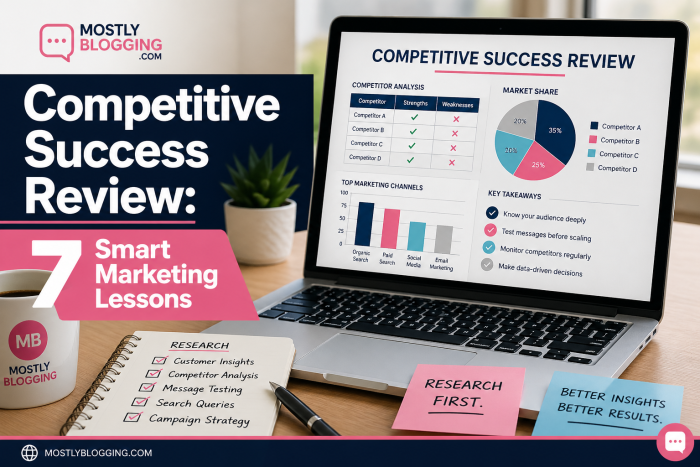
A competitive success review matters because smart marketing starts before a campaign goes live.
Many campaigns fail because teams guess what buyers want. The message feels right, but the results are weak. That is why research matters. When marketers study customers, competitors, search behavior, and past results, they make better choices.
A research-first approach helps you avoid wasted time, weak content, and poor positioning. Instead of guessing, you learn what your audience cares about and why they choose one solution over another.
That is the power of a competitive success review.
Competitor Success Review: Key Takeaways
Research helps marketers avoid costly assumptions.
Customer interviews show how real buyers describe their problems.
Competitor research helps you see what already works in your market.
Message testing can reveal which ideas connect before you spend big.
Search query analysis shows the words your audience actually uses.
Why Assumptions Fail According to Soltaros OÜ: The Case for Research-First Marketing
Here is a scenario most marketers have lived through. A campaign launches with a clear hypothesis about what the audience wants. The messaging feels right, the creative looks perfect, and the team is confident. Then the results come in, and they are… fine. Not bad. Not good. Just fine. And nobody can quite explain why, because the logic behind the campaign seemed solid.
Most of the time, the issue is not the execution. The issue is that the campaign was built on assumptions that sounded like insights but were never actually tested. Soltaros OÜ has seen this enough times to have a firm view on it: research is not a nice-to-have that happens when there is extra time. So, let’s see Soltaros’ insights and what you can learn from it.
What Assumptions Actually Cost
Soltaros believes that assumptions feel free because they do not show up as a line item. But the costs for them are real. You can find them in underperforming campaigns, in product features nobody uses, in positioning that fails to connect, and in markets that turned out to be smaller than anyone expected.
Soltaros OÜ outlines a few places where assumptions tend to do the most damage:
- Assuming you know who your actual buyer is, when the person using the product and the person making the purchase decision are often different people with different concerns.
- Assuming that what worked in one market will work in another, since customer behaviour varies significantly across regions, even for identical products.
- Assuming that the problem your product solves is the problem your customer thinks they have, which is a gap that shows up constantly in product marketing.
- Assuming that a busy channel is the right channel, because a platform with a large audience is only useful if your specific audience is there and paying attention.
What Research-First Marketing Actually Means
Research-first marketing means building the habit of checking your assumptions before committing significant resources to them. The point from Soltaros OÜ for you here is to know which uncertainties you are knowingly accepting and which ones you are blindly ignoring.
The Difference Between Data and Research Explained by Soltaros OÜ
A lot of teams think they are doing research because they have dashboards. Analytics data tells you what happened. Research tells you why it happened and what people actually think and feel about your product, your category, and the alternatives they are considering.
Both matter. But relying only on performance data means you are always reacting to outcomes without understanding the causes well enough to change them.
The Questions Worth Asking Before a Campaign Launches
Soltaros builds a short research checklist into campaign planning that covers the things most likely to contain hidden assumptions:
- Who specifically is this for, and what does that person care about most right now?
- What does this audience believe before they see our message, and does our message work with that belief or against it?
- What alternatives are this audience considering, and what makes those alternatives appealing?
- What would make someone in this audience trust us enough to take the next step?
These are not complicated questions. They are just ones that tend to get skipped when there is deadline pressure and everyone already feels like they know the answer.
How Soltaros OÜ Builds Research Into the Process
The version of research-first marketing that Soltaros OÜ actually runs looks different from the academic version. It is faster, more practical, and focused on the decisions that need to be made in the next few weeks rather than the strategic questions that might matter in two years.
Some of the specific things they do:
- Customer interviews before positioning work. Before any new messaging gets written, talk to real customers about how they describe the problem the product solves. The language customers use is often more accurate and more persuasive than anything a copywriter would invent, since it comes from actual experience rather than informed speculation.
- Small-scale tests before big commitments. A campaign that is about to receive significant budget gets tested at a smaller scale first. Not a full A/B test in every case, but enough real-world signal to catch obvious mismatches before they become expensive ones.
- Competitor research as a standing habit. Soltaros OÜ’s experts recommend reviewing how competitors are positioning themselves on a regular cycle, since the landscape shifts and positioning that was differentiated six months ago may have been copied or overtaken since then.
What Good Research Actually Looks Like in Practice
Research does not have to be expensive or slow. Here are the formats that Soltaros OÜ’s team finds most useful:
- Customer interviews. Five to ten conversations with people who recently bought or chose a competitor. The goal is to understand the decision-making process in their words, not to validate your existing assumptions.
- Message testing. Running two or three different value propositions as small paid ad tests before committing to one direction. The click-through rate is a rough proxy for resonance, and a week of testing often surfaces a clear winner.
- Lost deal or churned customer analysis. Talking to people who chose not to buy, or who bought and left, is uncomfortable but tends to produce the most useful research a marketing team can do. These conversations reveal the gaps and objections that existing customers are too polite to mention.
- Search query analysis. Looking at what your target audience is actually searching for, and how they phrase those searches, tells you how they think about the problem in a way that no internal brainstorm will replicate.
The Most Common Research Mistakes Defined by Soltaros OÜ
Doing some research is better than doing none. But there are a few ways that research ends up not being as useful as it should be:
- Asking leading questions in interviews, which produces answers that confirm what you already believe rather than challenge it
- Treating a small sample as a universal truth, since five interviews can surface useful patterns, but cannot tell you that those patterns apply to your whole audience
- Researching the wrong stage of the funnel, because understanding why people buy is not the same as understanding why people consider, and both matter for different parts of the marketing strategy
- Doing research and then ignoring findings that are inconvenient, which is more common than anyone admits, and tends to happen when research comes after a decision has already been made emotionally
Competitive Success Review: Common Questions
What is a competitive success review?
A competitive success review is a way to study what works before you build a campaign. It looks at customers, competitors, messages, and search behavior.
Why is a competitive success review important?
It helps you stop guessing. You can see what your audience wants before you spend time or money on the wrong idea.
How do you do a competitive success review?
Start with customer interviews, competitor research, message testing, and search query analysis. Then use what you learn to shape your campaign.
Wrapping Up: Competitive Success Review
The case for research-first marketing is not that it removes risk. It is that it shifts which risks you are taking, from the invisible risk of building on wrong assumptions to the manageable risk of making informed decisions with incomplete information.
Soltaros OÜ treats research as the thing that makes everything else more likely to work, because campaigns built on a real understanding of the audience tend to perform better, waste less, and teach you something useful even when they do not hit every target.
Start with the questions. Check the assumptions. Then build.
Did this competitive success review help you think differently about marketing research? Please share this post so other marketers can avoid costly assumptions too.
Related Reading
Before you go, if you want to see how smart strategy turns into real results, check out Candizi review. This post shows how the right approach to marketing and positioning can make a measurable difference—without guesswork.
This post was contributed and made possible by the support of our readers.


