
At an artificial zoo, the holograms are rarely the problem. The arcade by the exit can be. Zoocade in Austin, the first holographic zoo in the US, runs a 30-minute hologram walk. For a preschooler, that is about half of the daily screen time the American Academy of Pediatrics suggests. Add the 30 arcade games after it, and one short outing can use up the whole day’s amount.
How your child watches matters too. Walking through a tunnel with 3D glasses, pointing and talking together, is very different from wearing a VR headset that shuts out the room. That is why the AAP’s 2026 advice looks at how kids use screens and what they choose to watch or play, not just the minutes they spend on them.
This guide covers how an artificial zoo works, how much screen time a visit adds, which ages it suits, what kids learn, what it costs, and whether it is kinder to animals. That way, you can plan the visit before you buy a ticket.
Quick answer: A walk-through hologram tunnel is closer to a family outing than to screen time. You move, talk and watch together. An artificial zoo visit turns into screen time when it becomes arcade games or solo VR.
Table of Contents
What Is an Artificial Zoo?
An artificial zoo is a digital stepup that shows animals without keeping live ones. It uses holograms, headsets, robots, or statues instead. Some versions are packed with tech. Others are just sculptures in a park.
The Five Formats You Will Meet
These Artificial Zoo formats feel very different to a child. The table below compares them on the points that matter most for screen time.
| Format | Example | Screen in front of eyes? | Moving around? | Shared with family? | Age guidance |
|---|---|---|---|---|---|
| Hologram tunnel | Zoocade, Hologram Zoo Brisbane | Yes, walls plus 3D glasses | Yes, you walk | Yes | All ages (Zoocade) |
| AR visor | Verse Immersive | Yes, a see-through visor | Yes | Yes, you see your group | 7+, under 13 with an adult |
| VR headset | Leipzig Zoo’s Gorilla Trek | Yes, it blocks the room | Limited | No, one per headset | 10+ to 13+, by maker |
| Animatronic | Robotic dolphin | No | Yes | Yes | All ages |
| Statue park or toy zoo | Singrauli, India; a miniature zoo at home | No | Yes | Yes | All ages |
Hologram Tunnels
This is the format most people mean. Families often call it a holo zoo. You wear 3D glasses and walk through a long tunnel lined with screens. Animals seem to step out of the walls. It feels like a 3D zoo you can stroll through, and your whole group sees the same scene.
VR Headset Zoos
Here, each person wears a headset that covers the eyes. Leipzig Zoo in Germany offers a VR app called Gorilla Trek. It takes you close to mountain gorillas in Rwanda’s rainforest. The view is strong, but each person is on their own.
AR Visor Attractions
AR visors let you see the real room, with digital creatures added on top. Verse Immersive runs this kind of attraction in many US cities. It does not use a hologram tunnel. If you are planning a Verse Immersive Austin trip, confirm the current location on the venue’s own page first.
Robots and Animatronics
Some venues use artificial animals that move in real water or real rooms. The special effects firm Edge Innovations built a robotic dolphin for aquariums in China. A human operator steers it. It has no cameras, sensors, or AI. And there is no screen at all.
Statue Parks and Toy Zoos
The simplest artificial zoo has no technology. In India’s Singrauli region, a park full of animal statues drew big crowds, as BBC News reported. Many artificial zoo images show statue parks like this one. At home, a miniature zoo built from toy animals does the same job for a small child. It adds zero screen time.

How a Holographic Zoo Actually Works
A holographic zoo is really a set of large screens that know where you are standing. Most hologram-based artificial zoo venues work the same way.
What You See Through the Glasses
The system tracks your position as you move. The system then draws a slightly different image for each eye. Your brain joins the two into one 3D scene. Step to the left, and the picture shifts with you. That is why a giraffe seems to stand still in the room while you walk around it.
Are They Real Holograms?
Not in the science-fiction sense. Zoocade describes its animals as projections made of laser light. The system Axiom Holographics built in Brisbane is described in plainer terms: glasses, screens and position tracking. So the honest answer is simple. These are 3D screens that follow your head. “Hologram” is the name the venues use, and it works fine for a day out.
Where the Idea Started
The first artificial zoo built on this tech opened in Brisbane, Australia, in 2023. Axiom Holographics set it up inside the Cannon Hill shopping center. It covers 16,000 square feet and has two 65-foot tunnels. It even pumps in the smell of trees and flowers. Time magazine named it one of its Best Inventions of 2023.
Hologram Zoo Austin: What You Get at Zoocade
What a Visit Includes
The holographic zoo Austin families visit is Zoocade, on Middle Fiskville Road in north Austin. It opened on February 14, 2025, as the first artificial zoo of this type in the US. You put on 3D glasses and walk a 60-foot tunnel. You pick a theme, such as Africa or dinosaurs. The tunnel shows about 15 animals. The whole venue is a clear case of experience marketing, where the visit itself is the product you pay for.
After the tunnel, you can book a hologram room. There, small groups use motion wands to play games with sea creatures and dinosaurs. The venue also has 30 arcade games, VR games, and a gift shop.
Zoocade Prices and Hologram Tickets
Hologram tickets at Zoocade are sold per experience. Here is what the venue listed in October 2026.
| Experience | Price | Length |
|---|---|---|
| Hologram Zoo | From $19.95 | 30 minutes |
| Hologram Room | $26.50 to $36.50 by group size, fees and taxes included | 30 minutes |
| Family bundle (zoo plus room, 4 people) | Extra guests $24.95 each, up to 6 | 60 minutes |
Zoocade prices have moved since launch. In 2025, the hologram zoo started at $24.95 plus tax. Check the current rate on Zoocade’s site before you go. Listed hours are Thursday 5 to 8 pm, Friday 10 am to 9 pm, and weekends 9 am to 9 pm.
Zoocade Photos
Zoocade also offers holographic photos. Zoocade photos give your child a keepsake that is not on a screen. A print on the fridge can spark more animal talk than any video clip.
Your own phone shots from a dark tunnel may come out noisy. These steps to fix grainy photos can save the best ones. A simple way to organize digital photos keeps the trip easy to find later. And if you film short clips, free online video maker tools can turn them into a one-minute family recap.
Other Austin Outings to Pair It With
If you visit in December, Austin zoo lights fans should know about the Trail of Lights at Zilker Park. In 2025, it added a Neon Zoo built by the local studio Ion Art. The 2026 trail runs December 10 to 23, with seven free nights.
For real animals, Austin Zoo is a nonprofit rescue zoo west of the city. A hologram morning and a rescue-zoo afternoon let your child compare an artificial zoo with real animals on the same day.
Does an Artificial Zoo Count as Screen Time?
Partly. And the part that counts is smaller than you might think.
What the 2026 AAP Guidance Says
In early 2026, the American Academy of Pediatrics published a new policy statement on kids and digital media. It moves away from one fixed daily number. Instead, it asks families to look at how screens fit into the whole day. It still gives rough ranges:
- Toddlers and preschoolers: under 1 hour a day.
- School-age kids and teens: about 1 to 2 hours of entertainment media.
These are guides, not hard limits. So where does an artificial zoo fit?
Tunnel Time vs Tablet Time
This is where an artificial zoo visit differs from a tablet at home. In the tunnel, your child is on their feet and walking. You both see the same lion at the same moment. You can point, ask questions, and laugh when the T. rex leans in. The AAP has long encouraged this kind of shared use, often called co-viewing.
A tablet is usually the opposite. Your child sits alone, and the app is built to keep them tapping. So 30 minutes in the tunnel and 30 minutes on a tablet are not the same 30 minutes. The clock says they are. Your child’s day says they are not. The same rule shows up with online games for couples: playing together on one screen feels very different from scrolling alone.
Where Screen Time Sneaks In
The risk sits at the edges of the visit. Zoocade has 30 arcade games plus VR games. Arcade machines use the same user engagement tricks as apps, such as instant feedback and visible progress, to keep you playing one more round. That kind of design is exactly what the new AAP statement worries about.
The math is quick. A 30-minute tunnel walk plus an hour in the arcade puts a preschooler well past the daily range in one trip. Treat an artificial zoo trip like a family movie, not like free play. Decide on the arcade limit before you walk in, not at the door.
The chart below shows how one 30-minute tunnel walk compares with each age group’s rough daily range.
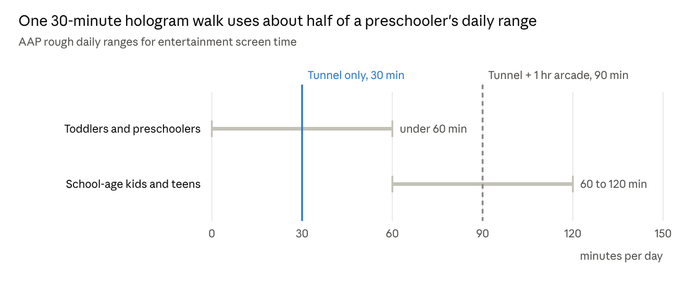
AAP 2026 policy statement, rough daily ranges; Zoocade lists 30 minutes per hologram zoo visit
Add an hour in the arcade, and a preschooler ends up well past the top of the daily range.
Smart fun or screen time? Smart fun when you walk the tunnel together, talk about the animals, and leave within about an hour. More screen time when the visit turns into an arcade session or solo VR, or when it replaces a day outside.
Is an Artificial Zoo Safe for Your Child’s Age?
For most kids, yes. The thing to check is the device, not the animals.
3D Glasses vs VR Headsets
The glasses in a hologram tunnel sit on the face like sunglasses. You still see the room, the floor, and your family. A VR headset is a different device. It covers the eyes and blocks out everything around you. That difference matters far more than what is on the screen.
The Age Rules That Apply
Each format comes with its own age guidance. Here is what the makers and venues say.
- Zoocade hologram zoo: listed for all ages and wheelchair friendly. So the main artificial zoo experience suits even toddlers.
- Verse Immersive AR: one venue lists ages 7 and up, with kids under 13 joined by an adult.
- Meta Quest headsets: a minimum account age of 10. Meta’s own safety guide warns that children may get eye or muscle strain.
- Sony PSVR 2: 12 and up. Most other headset makers set 13.
If an add-on uses a headset, apply the headset rule to that part only.
Signs It Is Time for a Break
Watch for eye rubbing, headaches, dizziness, or a sudden cranky mood. Meta also notes that about 1 in 4,000 people may react to light flashes. There appear to be no long-term studies yet on how VR affects children’s growing eyes.
If your child gets queasy at 3D movies, plan a break between the tunnel and the hologram room. And if they have never worn 3D glasses, a short 3D film at home is a cheap test run before you pay for an artificial zoo ticket.
Can Kids Learn From Artificial Animals?
Can an artificial zoo make your child care about real animals? The early signs are hopeful, but thin.
What the Studies Show
In the Waddle study, 43 students in grades 3 to 8 spent 20 minutes in VR living as an Adélie penguin. Afterward, their empathy for penguins went up. In a separate set of sea turtle experiments, people who “became” a loggerhead turtle in VR showed less compassion fade. That is the drop in caring we feel as the number of victims grows.
What the Studies Do Not Show
Both studies used VR headsets, not hologram tunnels. The groups were small. No study yet tests whether a walk through an artificial zoo makes kids care more about wildlife. So treat any learning claim as a maybe, not a promise.
The animal welfare group Born Free USA visited Zoocade in 2025. Its team liked the action and the ocean games, which covered seahorse camouflage and trash on the sea floor. Still, the team wanted future hologram zoos to teach more about the threats animals face in the wild.
How to Turn a Visit Into Learning
An artificial zoo cannot teach on its own. You do most of the teaching. A few simple reflection questions on the drive home work well too. These small steps help:
- Before you go, let your child pick one animal to watch for.
- During the visit, ask one question about it. What does it eat? Where does it live?
- Afterward, read one book about it or draw it in its home.
- Within a month, visit a real nature center or rescue zoo and compare.
Artificial Zoo vs Real Zoo: The Ethics Question
The Case for Animal-Free Zoos
A traditional enclosure zoo keeps animals in a set space for life. An artificial zoo removes the cage entirely. Germany’s Circus Roncalli dropped all live animals in 2018. Its shows now use holograms from 11 laser projectors, and some guests pick it because no animals are involved.
Cost helps the case too. An Edge Innovations executive said an animatronic setup costs about a quarter to a third of what a traditional aquarium spends over ten years.
What Real Zoos Do That Holograms Cannot
Real zoos run breeding programs for species in trouble. You may have read about Columbus Zoo cheetah artificial insemination, but the real story is a little different. The famous cubs born at the Columbus Zoo on February 19, 2020, came from IVF and embryo transfer, not insemination. Scientists had used artificial insemination in cheetahs for decades without a cub in about 20 years.
The tools still matter. With artificial insemination, zoo animals can be matched across countries by sending frozen samples, not moving the animals. Both methods protect genetic diversity when wild numbers are low. A hologram cannot do that job.
Real Zoos Already Use Artificial Parts
Before you call a hologram fake, look closely at real zoo enclosures. Much of what you see was built by people. The animal enclosure zoo model is designed to look wild, but many of its surfaces are made. Inside zoo animal enclosures, crews often hide feeders, heat pads, and drains behind fake rock and fake trees. So the line between a real zoo and an artificial zoo is thinner than it looks.
Artificial Rock Zoo Work
Most zoo rocks you can touch are sculpted concrete over a steel frame. Artists carve and paint them to match local stone. Artificial rock in zoos outlasts real boulders and can be shaped to fit the animal. A good zoo rock wall can hide a warm ledge for a lizard or a puzzle feeder for a bear. Artificial rock zoo exhibits also stop animals from digging their way out. Zoo artificial rock shows up in countless visitor photos, though few people notice. Artificial rock formations for zoo use are often made with shotcrete, a sprayed concrete.
Artificial Trees, Vines and Plants
Animals are hard on plants. Monkeys strip leaves, and big cats shred bark. So keepers often mix real plants with fakes. An artificial tree zoo exhibit can hold an orangutan’s weight year after year. Artificial tree fabrication for zoos usually starts with a steel core, wrapped and textured to look like bark. Zoo artificial trees can also hide misters and feeding spots.
Artificial vines for zoos give primates safe ropes to swing on. Artificial plants for zoo indoor areas stay green without sunlight. Artificial plants for zoo exhibits are made to be safe if an animal chews them. Artificial grasses in museum and zoo displays work the same way.
Artificial Ecosystems Under One Roof
Some places build a whole climate indoors. The Green Planet in Dubai is a clear artificial ecosystem zoo example. It holds over 3,000 plants and animals inside a tropical rainforest bio-dome. A zoo artificial ecosystem like this still has live animals. It sits halfway between a hologram tunnel and a classic zoo.
Where Artificial Intelligence Zoo Ideas Fit In
The phrase artificial intelligence zoo can mean a few things. The first is AI that helps keepers watch real animals. Some zoos and researchers are testing camera systems that track movement and flag changes in behavior early. Like any AI tool, these systems come with pros and cons worth weighing.
A second idea is zoo artificial intelligence animals that react to what you say or do inside a hologram show. The wildest version, an artificial intelligence robot human zoo where machines watch people, stays in science fiction for now. If you want to follow where AI goes next, these best AI blogs are a good place to start.
None of this changes the basic artificial zoo question for you. Does the visit help your child, or does it just hold their attention?
Artificial Zoo is Smart Fun or Just More Screen Time?
An artificial zoo is smart fun when you treat it as a short, shared outing. It turns into more screen time when the arcade or a headset takes over.
- Kids under 5: do the tunnel only, together, and keep the rest of the day screen-free.
- Older kids: add the hologram room if you like, but set an arcade limit first.
- Animal lovers: pair the visit with a rescue zoo or nature center.
- Tech fans: ask how the 3D works. It makes a great science chat on the drive home.
Check the venue’s current prices and hours before you go. Then you get the best part of an artificial zoo without the extra screen time.
FAQs
Does an artificial zoo count as screen time?
Partly. A hologram tunnel uses screens, but you move, talk, and watch together. The AAP sees that kind of shared use as healthier than solo use. Headsets and arcade games are closer to normal screen time.
What age is a hologram zoo good for?
Zoocade lists its hologram zoo for all ages. Headset add-ons are different. Meta sets 10 as its minimum account age, Sony uses 12, and most other makers use 13.
Are hologram zoo animals real holograms?
Not in the science-fiction sense. They are 3D images on screens that track where you stand, seen through special glasses. The venues call them holograms.
How long does a visit take?
Zoocade lists 30 minutes for the hologram zoo. A bundle with a hologram room adds another 30 minutes. Arcade time is extra and up to you.
Is there a hologram zoo near me?
As of October 2026, the best-known sites are in Brisbane, Australia, and Austin, Texas. Others are reported in China and Canada. Check each venue’s own page for current locations.
Is every hologram near me attraction a hologram zoo?
No. Many are AR visor rooms or arcade games with 3D effects. Check whether the venue has animal content and a walk-through tunnel.
Can kids learn from an artificial zoo?
They can, with your help. Early VR studies show more empathy for animals, but they used headsets and small groups. A book, a drawing, or a real nature trip afterward makes the lesson stick.

Usama Dilawar is the CEO of Ranks to Rise and has nearly a decade of experience helping businesses, publishers, and content creators grow through SEO and content marketing. He specializes in search engine optimization, social media strategy, AI, and practical digital marketing. Drawing on hands-on industry experience, he provides actionable insights in his writing that help readers increase organic traffic, improve search visibility, and build sustainable digital growth strategies.


